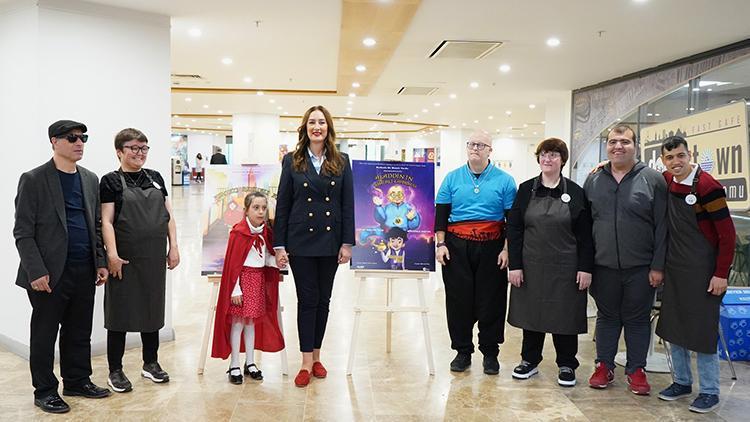
Little Red Riding Hood was the first of the ‘awareness-themed world classics’ created with the initiative of İZEV Foundation. In the new version of the fairy tale, Little Red Riding Hood, an individual with Down syndrome, and the wolf who wants to eat her join hands to defend animal rights. Fairy tales, purified from traumatic elements and reinterpreted with a comprehensive perspective, give the message of breaking the divisive stereotypes. A press conference was held at Sarıyer Down Town Cafe to promote the project and the book during Disability Week. Explaining the project at the meeting, İZEV Foundation Chairman Merve Kılıç said: “Fairy tales are works that are fundamental for generations of children to get to know life, make sense of it and gain their first life experiences. Many universal tales, which have become world classics, have been companions of millions of people since the times they were written and told until today. Children’s classics such as Pinocchio, Little Red Riding Hood, Don Quixote, and The Three Musketeers have been among the first heroes, first friends, and first books of all generations for hundreds of years. We wanted to benefit from the world and power of fairy tales, and to strengthen the dynamics that hold society together by standing against all kinds of discrimination. At a time when innovation is having difficulty keeping up with the speed of communication, change is no longer expressed in decades but months, and social needs are increasing rapidly, we are taking another step to break the mold. As Istanbul Education and Solidarity Foundation for Mentally Disabled People (İZEV), we are moving to the third phase of our project titled ‘Life and Us’. “Within the scope of our ‘Literature and Us’ project, we set out to update the world’s children’s classics according to today’s needs, from a perspective that is respectful of human life and rights, sensitive about the environment, nature and inequalities, and to deliver them to new generations in an inclusive language.” Stating that in the 10-book series prepared with the focus on the UN’s Sustainable Development Goals, universal fairy tales that have become cultural heritage were rewritten according to the realities of the modern age, remaining faithful to the original, Kılıç continued: “In the reinterpreted tales, it was important that characters with special needs were included in the plot and made heroes. The stories were intended to both reflect today’s world and give messages that will shape the future. We wanted to show that mentally and physically different individuals can also be heroes, be idolized, and be models for children, with the world’s most well-known fairy tale books and fairy tale characters. By adapting the fairy tales to today’s and tomorrow’s world, we stripped them of their sexist, racist, discriminatory and elitist aspects and created inclusive stories focused on the good and the positive, with the extraordinary sides of the characters defined as ‘disabled’. In the first phase, we target all children aged 3-13, their parents and teachers. In the second stage, special needs
