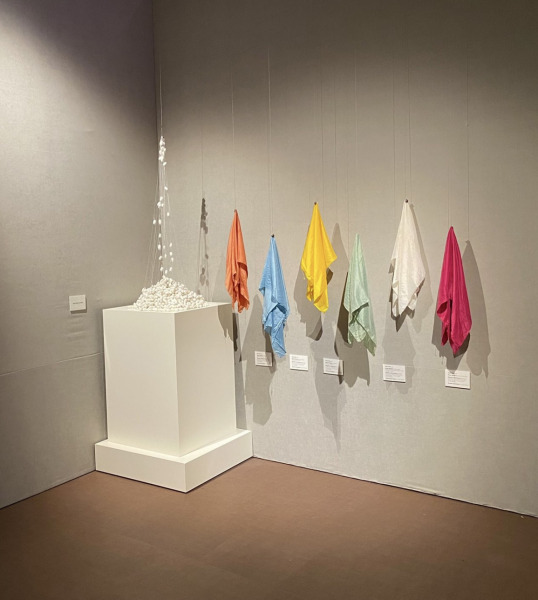
The “Weaving Atlas” project prepared under the auspices of President Recep Tayyip Erdogan’s wife Emine Erdogan, aiming to act as a bridge between the past and the future by bringing together the traditional weavings of Anatolia. Atlas” Exhibition was opened at the Tophane-i Amire Culture and Art Center in Istanbul after the Presidential Complex. The curator of the exhibition Güneş Güner; “We set out to research, protect, maintain, develop, strengthen, sustain the weaving culture of Anatolia for thousands of years, and pass it on from generation to generation by raising awareness,” he explains. One of the dreams of Güner, who spent most of her life intertwined with fashion and design, came true with this project. In this process, which he summarized as “Love loves coincidences”, his wishes came true step by step thanks to the project on Turkish Weavings of Beylerbeyi Sabancı Institute of Maturation. Emphasizing that she has the responsibility to explain the differences of local weavings within the scope of the project, Güner explains the development stage of the project as follows: “Ayse Dizman from Beylerbeyi Institute of Maturation started to work with various academicians to determine and identify the past and present situations of Turkish weavings belonging to seven geographical regions. . At the same time, Yusuf İyilik conducted research on sharing and exhibiting his unique collection, which he developed with this passion for weaving. Turkey Weaving Atlas Project continues to develop by including everyone who shares this ideal and wants to take this responsibility and curiosity into the process.”
Güner; He states that within the scope of the project, in which local weavings such as Üsküdar cross, Edirne red, Hatay silk, Denizli buldan cloth, Antep kutnu, Ankara ascetic, shawl şepik, ehram and beledi were brought together for the first time, academics and researchers carried out a joint study to determine the local differences of unique weavings. . Saying that Turkey has a geographically rich fabric content, Güner; “They are unique and inspiring with their fibers, colors and patterns. We sometimes witness great differences between woven fabrics hundreds of years ago and today’s fabrics.” is on display. Güner describes the relationship of the exhibition with the space; “To get to know Anatolia’s thousands of years of weaving culture, we were born from the old to the new.
