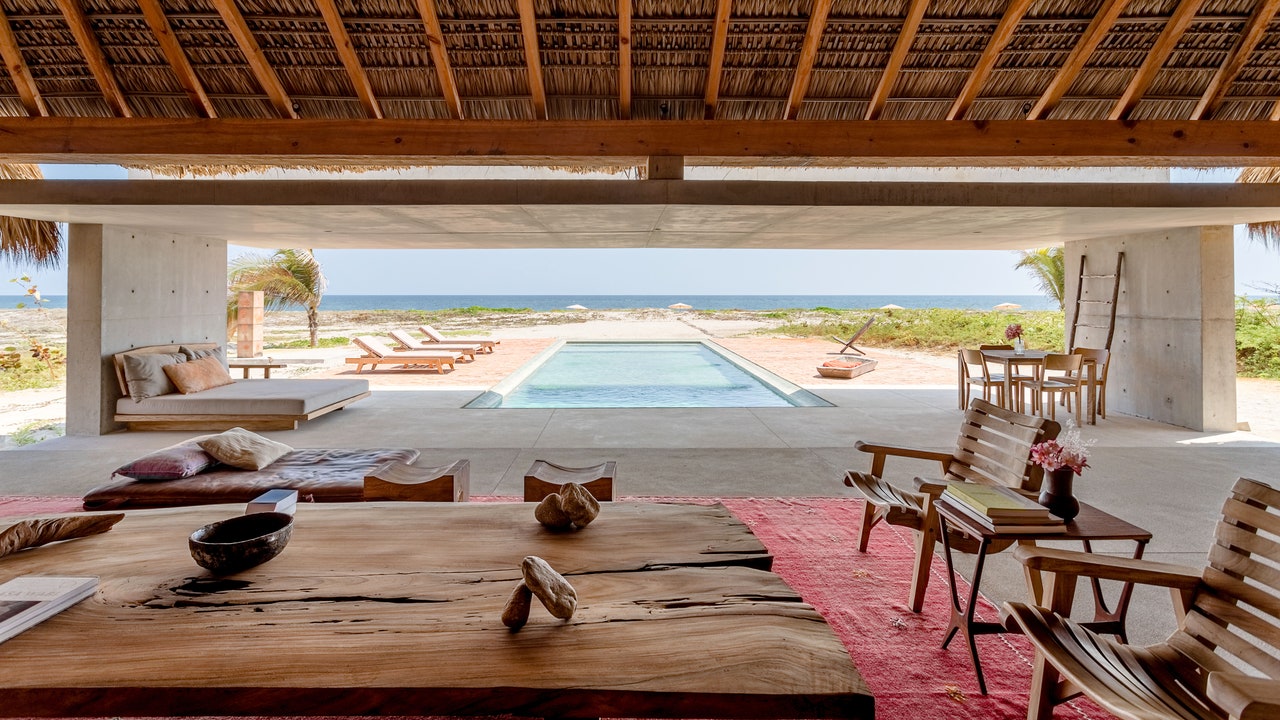
> “Things become more beautiful the more time passes. I want \n> to work with the elements, not against them.” *—Bosco Sodi*nnBosco Sodi understands the virtue of patience. For his best-known paintings, the artist slathers canvases laid flat with a heavy mixture of pigment, wood, glue, and natural fibers—engaging in an intensely physical and intuitive process, alone, for hours on end. Weeks or months then go by as that slurry dries into distinctive topographies, each work cracking at the whims of weather conditions, revealing unpredictable nuances of place. “Things become beautiful the more time passes,” says Sodi. “I want to work with the elements, not against them.”nnnn[#image: /photos/5f99b4264eeec5b37c62623d]|||Sodi and Corredor unwind poolside with their three children—Mariana, Bosco, and Alvaro—and dog Rey. The open-air residence comprises a series of traditional Oaxacan palapas, all topped with thatched roofs.|||nnThat was the idea behind his family’s new house in Puerto Escondido, a surfing hot spot on the Pacific coast of Mexico. Completed last year according to Sodi’s own designs, the beachfront home combines concrete, clay, and timber into a series of open-air palapas, the surfaces of which will weather with each salty breeze. Traditional Oaxacan thatched roofs offer shade from the harsh tropical sun, floor-to-ceiling openings frame ocean views, and walls of stucco and brick reveal the mark of local artisans. There’s no air-conditioning—just ceiling fans—and only spotty internet. Outside, a pool extends dramatically toward the waves, reflecting every sunset, every day gone by.nn+++group-2nnnn[#image: /photos/5f99b426e1e4da162bf23944]|||Sodi and Alvaro play ping-pong on a table designed by the Mexican atelier Taller Bok; the wall niches display an installation of Sodi’s burnt bricks.|||nnnn[#image: /photos/5f99b4224523106927c3aa41]|||In the kitchen, tile by the Mexican studio OmmMosaicos complements the exposed brick and concrete. |||nn+++nn“I am not an architect, but I wanted to experiment with the materials,” says Sodi, who, if not exactly an expert, certainly knows a thing or two about construction. Since 2013, he has transformed this scenic swath of sand into the artist residency and nonprofit foundation Casa Wabi, collaborating with some of the world’s leading architects to realize its campus, now a pilgrimage site among design lovers. Tadao Ando conceived the main structure, with his signature cast-concrete walls. Álvaro Siza, another Pritzker Prize winner, devised the ceramics studio, distinguished by a curved brick partition. It’s accompanied by a towering kiln by Alberto Kalach. And Kengo Kuma created a sculptural chicken coop of interlocking wood boards. Sodi took inspiration from each, assembling their precedents into a mixed-media homage.nnThis coastal stretch has, in many ways, been Sodi’s home away from home for decades. He first began camping along the coast as a teenager, later introducing the area to his wife, Lucía Corredor, cofounder of the Mexico City design shop and atelier Decada. After building two other houses with his father in Puerto Escondido, Sodi eventually bought Casa Wabi’s ocean-facing plot. “We fell in love with the energy of the place,” he says, adding that he and Corredor were always eager for their three children—Bosco, Mariana, and Alvaro—to experience that magic. “Because we live in New York, I wanted our kids to see their Mexican roots, to understand their culture.”nn+++group-2nnnn[#image: /photos/5f99b4207e487b84e7109bd9]||| Sodi in his Tadao Ando–designed studio with recent paintings on dried-chili sacks and ceramic sculptures in progress. |||nnnn[#image: /photos/5f99b4226bbf2361d2a10ece]|||The Decada lounge chairs are cushioned in [Sunbrella](https://www.sunbrella.com/){: target=
